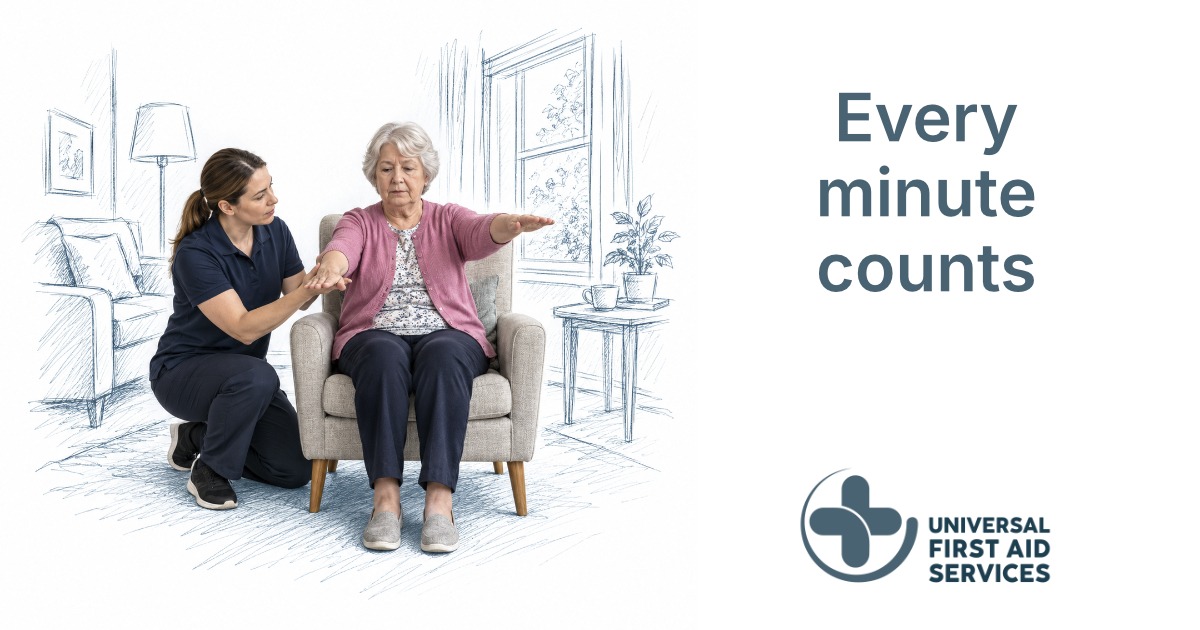
World Stroke Day takes place on 29 October each year. For 2026, the message from the World Stroke Organization is simple: Every Minute Counts.
When a stroke happens, recognising the signs quickly and getting emergency medical help can make a critical difference.
A stroke is a medical emergency. It happens when the blood supply to part of the brain is interrupted by a blockage or a ruptured blood vessel.
The sooner a person receives appropriate medical treatment, the greater the opportunity to reduce the damage caused by the stroke.
That is why knowing the signs matters.
Know FAST
One of the simplest ways to remember the main signs of stroke is FAST.
F — Face
Ask the person to smile. Has one side of their face dropped? Does their mouth or eye appear to droop?
A — Arms
Ask the person to raise both arms. Are they unable to lift one arm? Does one arm feel weak or numb?
S — Speech
Ask the person to speak. Is their speech suddenly slurred, confused or difficult to understand? Are they having difficulty speaking or understanding you?
T — Time
Time to call 112 or 999 immediately and ask for an ambulance.
You do not need to see every FAST sign before calling for help.
If you suspect a stroke, act immediately.
Do not wait to see if the symptoms disappear
Stroke symptoms can sometimes improve or disappear.
That does not mean the emergency has passed.
Symptoms that resolve quickly may indicate a transient ischaemic attack, or TIA, sometimes described as a “mini-stroke”.
A TIA still requires urgent medical assessment because it can be a warning sign of a future stroke.
If someone develops symptoms of a stroke or TIA, call 112 or 999 immediately and ask for an ambulance, even if the symptoms begin to improve.
Stroke can have other symptoms
FAST identifies many strokes, but not every stroke looks exactly the same.
Other sudden symptoms can include:
- Loss or blurring of vision
- Severe dizziness
- Loss of balance or coordination
- Confusion
- Difficulty understanding speech
- Difficulty swallowing
- Weakness or paralysis affecting one side of the body
- A sudden, severe headache
- Loss of consciousness
The important word is sudden.
If someone suddenly develops neurological symptoms and you suspect a stroke, seek emergency medical help.
Why every minute matters
The World Stroke Organization’s 2026 campaign focuses on the fact that time lost is brain lost.
Stroke treatment is time-sensitive.
The faster someone recognises the symptoms, calls for an ambulance and reaches appropriate medical care, the sooner specialist assessment and treatment can begin.
That is why stroke awareness is not only a healthcare issue.
It is something everyone can learn.
- You may be the colleague sitting beside someone at work.
- The coach standing beside a player.
- The family member at the kitchen table.
- The teacher in a classroom.
- Or simply the person who notices that something is suddenly wrong.
Knowing FAST gives you a simple framework for recognising what may be happening and taking the most important next step.
Call for help.
You do not need to diagnose a stroke
A first aider is not expected to diagnose a stroke.
Your role is to:
- Recognise that something may be seriously wrong
- Keep the person safe
- Call 112 or 999
- Follow the emergency call-taker’s instructions
- Monitor the person
- Be ready to respond if their condition changes
- Provide a clear handover when emergency medical services arrive
You do not need certainty before making the call.
If you suspect a stroke, treat it as an emergency.
Stroke recognition is part of first aid training
Recognising stroke is included in several first aid and cardiac-response programmes because early recognition can make such an important difference.
At UFAS, learners are taught not simply to memorise an acronym, but to recognise when a person may be seriously unwell and understand what action needs to happen next.
- That is where practical training matters.
- Knowing what FAST stands for is useful.
- Being prepared to act when you see those signs is even more important.
This World Stroke Day, learn one word: FAST.
Face.
Arms.
Speech.
Time.
Share it with someone else.
Talk about it in your workplace.
Mention it to your family.
Make sure the people around you know that stroke is an emergency.
Because when a stroke happens, every minute counts.
If you suspect a stroke, call 112 or 999 immediately and ask for an ambulance.
Learn practical emergency response skills with UFAS
UFAS provides practical first aid, Cardiac First Response and workplace emergency training for individuals and organisations across Ireland.
Our courses teach learners how to recognise serious medical emergencies, respond appropriately and provide care while waiting for professional medical assistance.
If you would like to arrange first aid or cardiac-response training for your workplace, team or organisation, talk to UFAS.
Call 01 699 1126
Email info@ufas.ie